CAPTURE
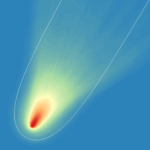
CAPTURE performs the following tasks based on equations that are presented in Bear and Jacobs (1965) and Kasenow (2010). These equations assume zero recharge, uniform aquifer properties and a non-zero hydraulic gradient.
- Calculates the infinite-time capture zone of an extraction well.
- Calculates travel times to the extraction well from points within this zone.
- Repeats these calculations for many stochastic realizations of:
- hydraulic conductivity;
- porosity;
- groundwater gradient;
- groundwater gradient direction.
- After performing these calculations, CAPTURE records probabilities, evaluated over a grid, that the travel time is less than a user-specified threshold in a number of different files.
- Optionally, CAPTURE records stochastic travel times at user-supplied observation points so that travel time histograms can be constructed at these points.
All CAPTURE outputs are recorded using real-world coordinates. Hence they can be overlain on maps and images of a study area.
Automated Spring Capture Zone Analysis
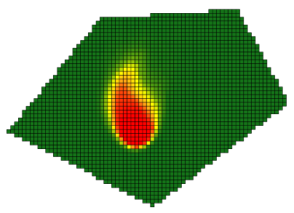
Watermark Numerical Computing, in conjunction with HydroSymple, has developed a suite of programs that collectively comprise an easy-to-follow but comprehensive workflow for spring capture zone analysis.
First, using a small set of points, define a model domain that surrounds a spring. Assign heads to these points; associate uncertainties with these heads if you are unsure of them. Programs of the workflow then:
- generate a MODFLOW 6 grid;
- generate stochastic expressions of spatially variable hydraulic conductivity and porosity;
- adjust hydraulic conductivity fields so that modelled spring flow matches observed spring flow;
- release particles throughout the model domain;
- evaluate probability of capture within a user-specified time for all model cells;
- generate pictures for GIS overlay.
All of this is done within a matter of minutes.
VOROGRIDGEN: Voronoi Mesh Generation for MODFLOW 6
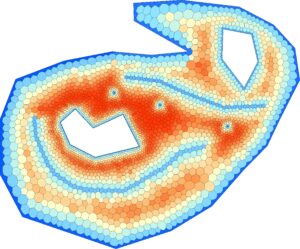
VOROGRIDGEN is an easy-to-use, stand-alone program that generates a Voronoi mesh for MODFLOW 6 according to user specifications. Cell sizes can vary throughout a model domain, becoming smaller (if desired) at inner/outer boundaries and/or at internal lines and points.
VOROGRIDGEN writes a MODFLOW 6 DISV file for a single or multilayer model. It also writes a basic, complementary MODFLOW 6 input dataset which can be modified to suit your own needs. It comes with utility programs that enable the writing and parameterization of polylinear boundary conditions based on intersections of lines with an arbitrary MODFLOW 6 DISV mesh. These utility programs are under continued development.
